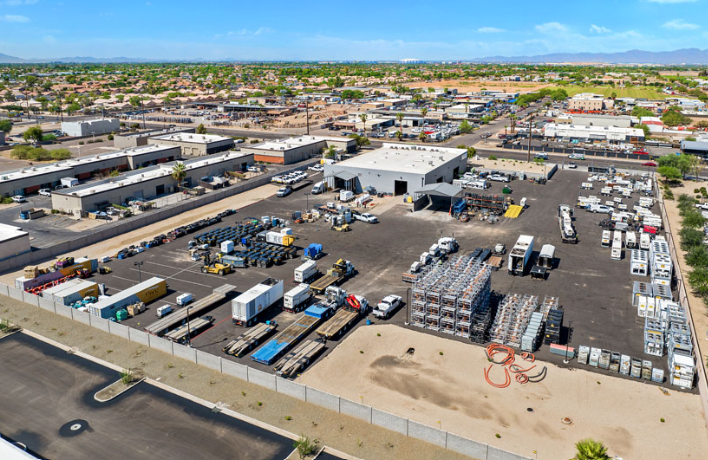

A fenced, paved lot with a small maintenance shed in the corner doesn’t look like much on paper. For years, that’s exactly how lenders and county assessors treated it: a throwaway building with some excess land attached. That assumption is now badly out of date. Industrial outdoor storage, known in the industry as IOS, has gone from a contractor-yard afterthought to one of the fastest-growing niches in commercial real estate. It’s also turning into one of the harder property types to appraise correctly, and Hampton Roads sits squarely in the path of the demand driving it.
An Asset Class That Outgrew Its Own Paperwork
The numbers behind this shift are hard to ignore. Newmark’s research puts IOS rent growth at 123% since 2020, more than double the 58% posted by bulk warehouse space over the same stretch. Five-year annualized returns on IOS have outpaced the broader industrial sector by 126 basis points. Newmark estimates roughly 1.4 million acres of IOS nationwide, an area about the size of Delaware, with a conservative market capitalization near $200 billion for the portion that’s readily tradeable. Vacancy sat around 5% in mid-2025, while bulk warehouse vacancy had climbed past 8%. Large institutional buyers have taken notice. J.P. Morgan Asset Management sold a 51-property IOS portfolio for $490 million, and Realterm paid $277 million to acquire assets from Brookfield. The number of IOS properties tracked inside NCREIF’s institutional property index has more than doubled in five years.
Here’s the catch: the data infrastructure hasn’t caught up to the capital. As one industry report on the sector put it bluntly, “there is still no CoStar for IOS.” Estimates of total 2025 transaction volume range from $1.5 billion to as much as $16 billion, depending on who’s counting and what they include. Colliers has flagged rising underwriting scrutiny around zoning, entitlement risk, and environmental conditions, and notes that buyers and sellers in this sector remain far apart on price. GlobeSt reports the same gap, adding that many owners now understand the intrinsic value of their sites well enough to simply refuse offers below it. Thin data and a widening price gap are not a combination that produces clean appraisals.
Why a Small Building on a Big Lot Isn’t Underimproved
The core appraisal problem with IOS is that building-driven metrics point you in the wrong direction. Picture a five-thousand-square-foot maintenance building sitting on eight paved acres. Run a conventional building-value-per-square-foot analysis, and the price looks absurd for such a small structure. But the buyer isn’t paying for the building. They’re paying for the ability to operate across all eight acres, and the yard is what’s actually generating the rent. A small building on a large, well-configured site is not an underimproved property waiting for a better use. In a lot of cases, it already is the better use.
Industry advisors tracking the Mid-Atlantic sector have settled on six traits that separate a strong IOS site from a weak one: location relative to highways, ports, and customers; durable entitlements and a clean environmental profile; usable site area rather than raw gross acreage, since wetlands and setbacks can quietly eat into what’s actually rentable; yard infrastructure like heavy-duty paving, drainage, fencing, and lighting; circulation, meaning wide curb cuts and adequate turning radii for large trucks; and operational flexibility to serve more than one type of tenant. None of those show up on a standard improvement schedule. All of them drive rent.
Hampton Roads Sits Right in the Path of This Demand
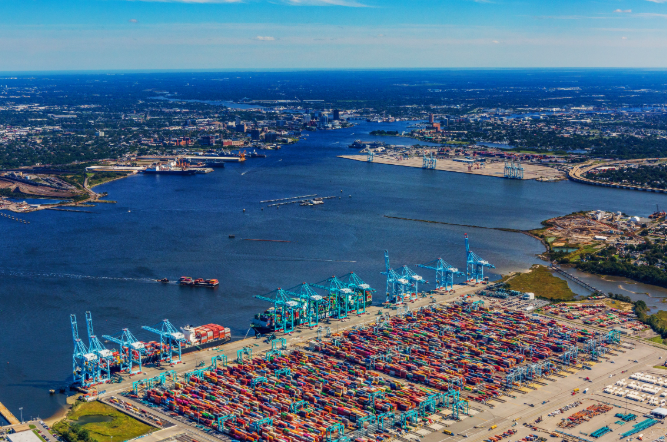
One Mid-Atlantic market analysis classifies Richmond–Hampton Roads as an “Established” IOS market, a tier below the gateway markets of Northern Virginia and Baltimore-Washington but ahead of up-and-coming corridors still waiting for capital to find them. That ranking tracks with what we already know about this region. The deep-water capacity we wrote about just last week doesn’t only create demand for warehouse buildings. It creates demand for trailer staging, container storage, and drayage support, exactly the uses that compete hardest for IOS space. A port moving more freight needs somewhere for the trucks and chassis to sit between loads, and that somewhere is rarely a conventional industrial building.
It also creates the same friction we saw play out at Port 460 in Suffolk, where road capacity and stormwater concerns slowed a logistics park’s path through entitlement. IOS sites draw a similar reaction from local governments, often a sharper one. They typically generate fewer jobs, less building investment, and lower tax revenue per acre than a comparable warehouse, which gives planning commissions less incentive to approve them and more reason to worry about truck traffic, noise, and lighting. Supply stays tight as a result, which is exactly the kind of constraint that pushes rents and values higher for the sites that already have the right zoning in place.
What Happens When There’s No Comp?
This is where the appraisal assignment gets genuinely difficult. A per-acre or per-square-foot shortcut can miss 30% to 50% of the actual rent difference between two sites with identical acreage and zoning, once you account for paving load capacity, power service, drainage, and stacking depth. Power in particular has become a real underwriting debate. Some investors cite a 20% to 30% premium for a fully powered, turnkey yard, but without signed leases to back that number up, which means an appraiser should credit documented capacity and executed leases rather than a landlord’s claim that “power is available.”
Lease structure has shifted too, and it’s evidence worth tracking closely. Average lease terms in the institutional end of the sector grew from two to three years in 2023 to four to six years in 2026, with weighted average lease terms nearly doubling over roughly the same period. Cap rate spreads between IOS and conventional industrial have compressed from a historical gap of around 150 basis points down to somewhere between 25 and 50 basis points in several markets, though thin transaction volume means that compression is still an estimate rather than a settled number. Environmental conditions add another layer entirely. A yard with a deed notice tied to prior contamination might get priced 50 basis points wider than a clean comparable if a long-term lease is in place, but closer to 100 basis points wider if the site sits vacant. None of these adjustments come from a standardized data set. They come from an appraiser who has actually walked the site, pulled the zoning history, and understands what similar yards are doing in this specific submarket.
A Different Kind of Due Diligence
For owners of contractor yards, truck lots, and laydown space across Hampton Roads, the lesson here isn’t that their property just became more valuable, though in many cases it has. It’s that the old approach of treating the building as the asset and the yard as an afterthought no longer produces a defensible number, for a lender, a tax appeal, or a sale. An appraisal of an IOS property needs to start from the yard outward: its entitlements, its usable acreage, its infrastructure, and the lease evidence from genuinely comparable sites, not a generic industrial comp pulled because it happened to sell recently. As institutional capital keeps moving into this sector and the data gap behind it slowly closes, the appraisers who already know how to read a yard correctly are going to matter more, not less.