
Hampton Roads just got the deepest commercial shipping channel on the East Coast, and in response, the region’s industrial developers have paused almost every speculative project they had on the drawing board. Those two facts sound like they belong in different stories. They don’t. For appraisers valuing warehouse, distribution, and logistics real estate in this market, they’re the same story, and reconciling them is the actual assignment.
A Record-Deep Harbor Built for a Decade That Hasn’t Arrived Yet
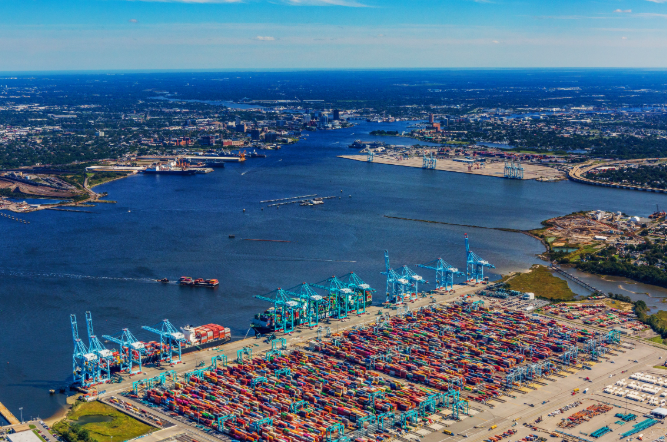
The Virginia Port Authority finished dredging Norfolk Harbor’s shipping channel to 55 feet this past June, a $450 million project that makes it the deepest commercial channel on the East Coast. Ships can now move in and out without waiting on the tide. New berth space and cranes let the port handle four ultra-large container vessels at once, and an expanded rail yard inside Norfolk International Terminals now processes 2 million rail units a year, part of a push to shift more cargo off local highways. All of this sits under the port’s $1.4 billion Gateway Investment Program, which is on track to wrap up by the end of 2027.
Here’s the part worth sitting with: port officials have said openly that demand will take time to grow into the capacity they just built. The long-term target is around 6 million TEUs a year, and current throughput isn’t close to that number. This is infrastructure built for a decade-out forecast, not a response to today’s cargo volumes, and that distinction matters enormously for anyone trying to value land or buildings around it. A port betting on 2035 numbers and a market pricing off 2026 numbers can disagree for a long time before either one is proven right.
Why Is a 5-Million-Square-Foot Bet Moving Forward While Everyone Else Waits?
The Hampton Roads industrial market is still working through a rough patch, though the edges are starting to turn, according to Thalhimer’s Q3 2026 Hampton Roads industrial MarketBeat report. Vacancy eased to 7.6% in the third quarter, down from the second quarter’s high. Net absorption turned positive for the quarter, about 50,900 square feet, although the year-to-date figure is still slightly negative. Under-construction space has shrunk to roughly 2.1 million square feet, well below where it stood earlier in the year, and the report notes that almost every other planned speculative project in the region is currently on hold. Leasing is up, topping 2.3 million square feet for the year, with new entrants and growing demand tied to defense contractors and defense-technology firms, including the ripple effects of a $76.6 billion Navy contract awarded to HII and Newport News Shipbuilding. Sales volume has pushed past $600 million year-to-date. Buyers are still writing checks for this market even as most developers sit on their hands.
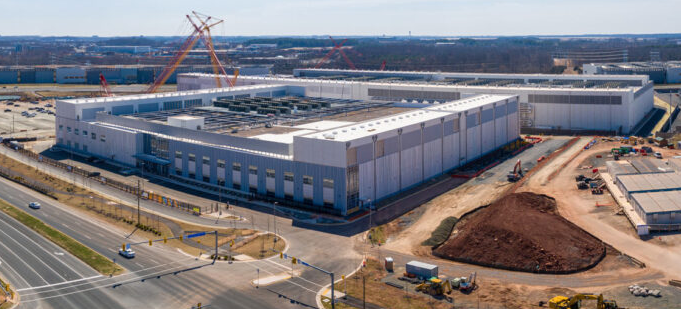
Almost every developer, except one. The same Q3 report names just a single active speculative building in the entire region: a 1-million-square-foot facility inside Port 460 in Suffolk, where walls went up during the quarter. That project traces back further than this year. The 540-acre site straddling U.S. Routes 460 and 58 in Suffolk first came up for rezoning in July 2022, when the city’s Planning Commission voted 5-3 to recommend shifting it from general commercial and agricultural use to heavy manufacturing. The hearing drew real pushback. Neighboring Nansemond-Suffolk Academy warned that an estimated 8,944 additional daily vehicle trips on Route 460 would put its students, and its share of new teen drivers, at risk. Other residents raised stormwater and truck-traffic concerns along Pitchkettle Road. The rezoning passed anyway, with the developer committing roughly $30 million toward road improvements plus another $6.6 million split between preliminary engineering on Route 460 and interchange work at Routes 58 and 460.
Matan Companies, based in Frederick, Maryland, ran that two-year entitlement process before bringing in Rockefeller Group as a development partner in November 2023, with JLL handling both the capital raise and the leasing assignment. What’s now known as Port 460 Logistics Center broke ground on its first phase in 2025: five buildings totaling 2.4 million square feet, with an initial 500,000 square feet delivering first and the rest following by the first half of 2026, at a projected phase-one cost of roughly $330 million. The full build-out plan calls for about 4.7 million square feet across ten buildings plus retail frontage along Route 460, with total construction costs estimated near $420 million and more than 9,000 permanent jobs projected once complete. The park landed its first confirmed tenant in December 2025, when less-than-truckload carrier A. Duie Pyle paid $24 million for a 43-acre parcel inside the campus. Pyle’s facility there pairs a 52-door LTL cross-dock with 200,000 square feet of warehouse space, expandable to 420,000 square feet, and it’s slated for completion in the second quarter of 2027.
This project isn’t an abstraction for us. McCoy Valuation appraised Buildings 1 and 2 of Phase I back in 2024, while the project was moving out of entitlement and into the development-financing stage that eventually brought Rockefeller Group’s capital to the table. That gives us a direct, ground-level view into exactly the tension this post is describing, and not just in the abstract. Appraising specific buildings inside a multi-phase megaproject means underwriting a rent roll that didn’t fully exist yet, against a backdrop where the rest of the park, and the broader market around it, was still years from proving out the port’s long-range capacity thesis. That’s a different exercise than valuing raw acreage, and it’s the kind of assignment where local, on-the-ground familiarity with a project matters more than a generic market report ever could.
What This Divergence Means for an Appraisal
A market where most developers have stopped building speculatively, while one megaproject keeps adding buildings anyway, puts real pressure on how a valuation gets built. A land residual analysis for a port-proximate parcel has to decide how much weight the port’s own 6-million-TEU target deserves against a market where almost nobody else is willing to bet on near-term absorption. Lean too hard on the infrastructure narrative, and the appraisal risks pricing speculative land off a ten-year promise rather than today’s market. Lean too hard on the pause everyone else has taken, and it risks missing exactly what the capital markets are already pricing in: that more than $600 million in year-to-date sales volume isn’t flowing from investors who think this market has peaked. Multi-phase megaprojects like Port 460 add their own wrinkle. A market study supporting a 2.4-million-square-foot phase one has to model absorption across several years and several delivery dates, not a single snapshot, and the fact that the rest of the region’s developers are standing on the sidelines is itself a real input into how fast that absorption should be expected to happen.
Reading the Market Correctly Before the Capacity Catches Up
None of this means the port’s bet is wrong, and it doesn’t mean the broader pause on speculative construction is a red flag investors should ignore either. It means an appraisal in this specific market, right now, has to hold both realities at once and say plainly which one is driving which conclusion. A build-to-suit valuation anchored to a defense contractor’s lease commitment is a different exercise than pricing raw land speculatively near a rail yard that won’t be fully utilized for years. Owners, lenders, and developers moving on industrial sites in Suffolk, Chesapeake, or anywhere else along the port’s supply chain should expect their appraiser to walk through that distinction explicitly, not average it away. The port’s capacity is real and arriving on schedule. Whether the rest of the market catches up to it on the same schedule, or waits for Port 460 to prove the thesis first, is still an open question, and that’s exactly the kind of open question a careful valuation is supposed to answer.