
Every commercial property owner budgets for the predictable costs: debt service, taxes, utilities, maintenance. For most of the last five years, one line item that used to be an afterthought, property insurance, has instead become one of the fastest-growing and least predictable expenses on the operating statement. The national headline for 2026 is relief: broad property insurance pricing is finally easing after years of double-digit increases. But in Hampton Roads, where storm surge exposure ranks among the highest in the country, that relief is arriving unevenly, and the gap between what owners pay nationally and what owners pay here is becoming a valuation issue in its own right, not just an insurance one.
What’s Happening With Commercial Property Insurance Right Now?
The run-up has been dramatic. A recent Brookings Institution analysis found that average commercial property insurance premiums grew more than 15% annually between 2019 and 2024, with increases approaching 30% in 2023 alone, and insurance costs have roughly doubled as a share of rental income and operating expenses over that five-year span. Early in that run, owners were able to pass roughly half of those increases through to tenants in the form of higher rents. By 2024, Brookings found, that pass-through mechanism had largely broken down, and landlords began absorbing most of the increase directly through reduced profitability instead. The report’s authors put it plainly: rising insurance costs are “becoming capitalized into commercial real estate values.”
2026 is bringing a measure of relief, at least on paper. According to Marsh McLennan Agency’s 2026 real estate industry outlook, property insurance pricing has decreased 10% to 20% across many asset types this year as surplus line insurers expand capacity, following a relatively calm 2025 catastrophe season. Insurers are showing renewed willingness to underwrite older, coastal, and otherwise complex properties that had become difficult to place just a year or two ago. That is genuinely good news for a majority of owners nationally. It is also not the whole story, because property insurance and flood insurance are underwritten separately, and the flood market is not experiencing the same relief.
How Does Insurance Actually Factor Into an Appraisal?
For appraisers, insurance is not a side issue; it runs directly through two of the three approaches to value. In the income approach, insurance premiums are a direct operating expense deducted from effective gross income to arrive at net operating income, so a spike in premiums lowers NOI and lowers value under a direct capitalization analysis before a cap rate is even applied. Separately, the availability and cost of insurance shapes the cap rate itself: the Brookings research found that in areas with the steepest insurance increases, NOI has declined by more than 25% over the past decade, and properties in higher-risk locations increasingly sell at lower prices and higher capitalization rates as buyers price in the ongoing insurance drag on returns. In the cost approach, replacement cost estimates and insurable value are closely linked, which means a property that is underinsured relative to its true rebuild cost, a common problem when premiums spike and owners cut coverage to control costs, can create a mismatch between what the market expects a lender to see and what a policy will actually pay out after a loss. When coverage is capped, hard to obtain, or carries so large a deductible that it no longer functions as real risk transfer, that is a form of economic obsolescence an appraiser has to account for, not a footnote to leave out of the report.
Why Is Hampton Roads a Special Case?
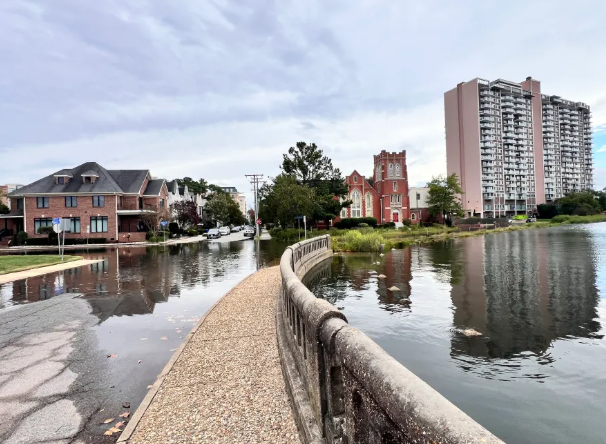
This is where the local picture diverges sharply from the national narrative. Virginia Business reported that the commercial flood insurance market has deteriorated steadily since Hurricane Ian in 2022, and Matthew Thompson, a vice president at Marsh McLennan Agency with more than 13 years in commercial flood insurance, described current conditions bluntly: “pretty bleak,” and “probably the worst maybe it’s ever been.” Carriers that remain in the market are writing policies on terms far more favorable to themselves, with higher deductibles and tighter conditions, while others have pulled back capacity significantly or exited flood coverage altogether. Commercial NFIP policies cap out at just $500,000 in damages with no business interruption coverage included, and when lenders require coverage beyond that cap, owners are often left negotiating costly supplemental private policies or expensive waivers just to close a loan. The exposure behind these numbers is substantial: Hampton Roads ranks fifth nationally for storm surge risk, with estimated reconstruction costs exceeding $122 billion as of 2023, according to the same report. In other words, the region sitting on some of the country’s highest flood exposure is also the region least likely to benefit from the 10% to 20% national property insurance relief everyone else is reading about, because that relief is concentrated in general property coverage, not the flood policies Hampton Roads owners depend on most.
What Does This Mean for Owners and Lenders Here?
Layer this onto the stories we have been tracking the past two weeks, the Fed’s September rate hike holding cap rates elevated and keeping negative leverage in play across the region, and the wave of CMBS office loans heading toward distress at refinance, and insurance becomes a third, often overlooked pressure point on the same properties. A building with softening NOI from a tough leasing market and a higher cap rate from a tougher rate environment is now also absorbing a flood insurance renewal that may be flat to worse year over year, even as national headlines describe a market that is easing. For owners near the water, which in Hampton Roads is most of the commercial inventory, that combination can turn a routine insurance renewal into a real drag on refinancing capacity, and it is exactly the kind of fact pattern a lender’s appraisal, or a special servicer’s, will be built to capture. Owners who are not tracking how their own insurance costs compare to the broader “relief” narrative risk being surprised by a value conclusion that assumes national trends apply locally when, on the flood side, they largely do not.
What Should Property Owners Do Now?
Start by pulling your last two to three years of property and flood insurance renewals and looking at the trend line, not just the most recent bill. If premiums have climbed faster than your rents or your NOI has grown, that gap belongs in any current valuation discussion, whether you are heading into a refinance, a sale, or a tax appeal. It is also directly relevant if you believe your real estate tax assessment has not caught up to what rising, uneven insurance costs are doing to your property’s net income; an assessor working from last year’s comparable sales may be missing exactly the kind of localized, flood-driven expense pressure described above. An independent appraisal that reflects your property’s actual insurability, not a generic assumption that national rate relief has reached every asset equally, gives you a defensible number to bring into any of those conversations. If you have not had your coverage, your replacement cost estimate, and your appraised value reviewed together in the past year, now is a reasonable time to do it, before a lender, a servicer, or an assessor does it for you.